
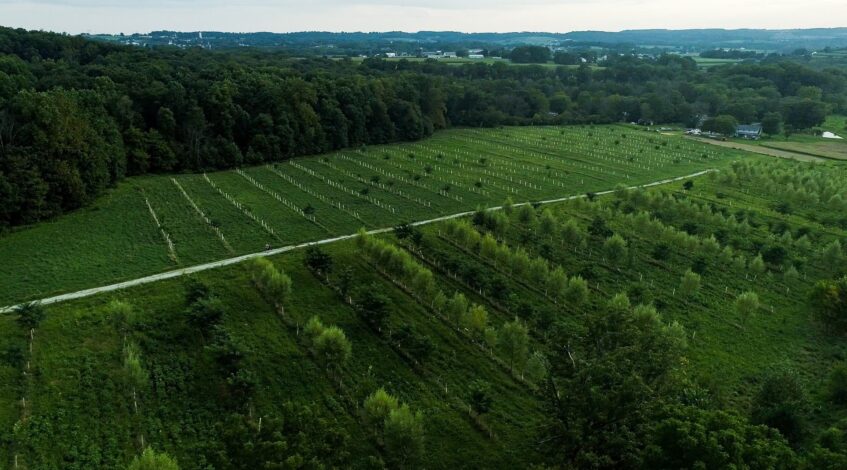
Agroforestry is becoming an increasingly visible practice in Central European countries, including the Czech Republic, where sustainable land use and environmental protection are coming to the forefront. This approach combines agriculture with elements of forestry, allowing for the efficient use of natural resources, improved soil fertility, biodiversity conservation, and reduced risks associated with climate change. Unlike traditional farming, where fields are completely cleared of trees and shrubs, agroforestry offers the integration of various plant components on the same land.
As the Czech Republic faces issues such as soil erosion, droughts, and biodiversity loss, agroforestry can become an essential part of sustainable agricultural policy. It is applicable both on large farms and small family plots, providing not only economic benefits but also long-term landscape protection.
Main Forms of Agroforestry
There are several forms of agroforestry, each adapted to local climate and soil conditions. One of the most common types is the placement of tree species along field edges—windbreak strips. These strips reduce wind speed, prevent soil erosion, and create a microclimate more favorable for agricultural crops. In areas like Moravia and South Bohemia, where drought is becoming more frequent, such systems help retain moisture in the soil.
Another form involves growing crops between rows of trees. For example, walnut, chestnut, or fruit trees can coexist with grain crops or forage grasses. This approach not only increases land productivity but also helps build a resilient ecosystem where plants interact and support each other. Additionally, the shade from trees helps lower soil temperatures and reduce evaporation, which is especially important during hot summer months.
A third direction is silvopastoral systems, where trees grow on pastures, providing shade and feed for livestock. This is particularly effective in organic livestock systems, which are gaining popularity in the Czech Republic. Silvopastoral systems allow for the combination of sheep, goat, or cattle grazing with forest conservation.
Environmental and Economic Benefits
Agroforestry has numerous advantages. One of the key ones is improved soil health. Leaf litter and tree root systems contribute to the accumulation of organic matter, making soil looser and more fertile. Moreover, deep tree roots extract nutrients from lower layers, making them available to other crops.
Ecologically, agroforestry plays an important role in fighting climate change. Trees actively absorb carbon dioxide, reducing the overall amount of greenhouse gases in the atmosphere. In the Czech Republic, where natural forests have been significantly cleared in the past, such systems help recreate sustainable ecosystems and provide habitats for insects, birds, and small animals.
From an economic point of view, agroforestry can be a profitable solution for farmers. It reduces crop failure risks by providing alternative income sources—for example, from the sale of timber, fruits, nuts, or honey. The multifunctionality of land makes farming more flexible and resistant to market fluctuations.
Development Prospects in the Czech Republic
Today, agroforestry in the Czech Republic remains a relatively new practice, although interest in it is growing. Within the framework of the EU’s Common Agricultural Policy, there are support programs for sustainable farming methods, including subsidies for tree planting and the creation of buffer zones. Some universities, such as the Czech University of Life Sciences in Prague, conduct research and field experiments aimed at adapting agroforestry to Central European conditions.
An important direction is also the involvement of local communities and farmers through pilot projects and demonstration farms. Thanks to such initiatives, farmers can exchange experiences, share knowledge, and adapt it to their conditions. The flexibility of the agroforestry model allows it to be implemented not only in rural areas but also near cities—as part of urban greening and food security policies.
Conclusion: Uniting Nature and Agriculture
Agroforestry offers a balanced path between productive agriculture and nature conservation. It allows for the creation of a more sustainable and environmentally friendly farming system that considers the interests of both farmers and future generations. In the face of climate challenges confronting the Czech Republic, this approach can play a key role in transforming the agricultural sector, opening new opportunities for sustainable growth and ecological restoration. It is not just a method of farming but a philosophy of harmonious coexistence between humans and nature. By integrating trees into agricultural landscapes, farmers not only diversify their production but also build natural resilience against environmental risks. In this way, agroforestry contributes to both ecological regeneration and rural prosperity.